My husband and I had a rare night out a couple of weeks ago. We left our very capable children at home and in charge of their own dinner.
My fifteen-year-old daughter—who is a natural caretaker—made pasta for her brothers and herself. It felt like a win.
But when we walked through the door later that night, the kitchen looked like a bomb had gone off. It was completely full of their dirty dishes.
Without saying a word, my husband immediately stepped up to the sink and started scrubbing. That’s usually his job in our house, a luxury that routinely makes my girlfriends green with envy. Of course, he and I grumbled to one another under our breaths, but we cleaned it anyway. It’s become a common cycle.
The very next weekend, I found myself at a dance competition with my daughter. On the final day, as she and her best friend casually headed down to their morning masterclasses, my roommate and I began the grueling process of packing up the hotel room.
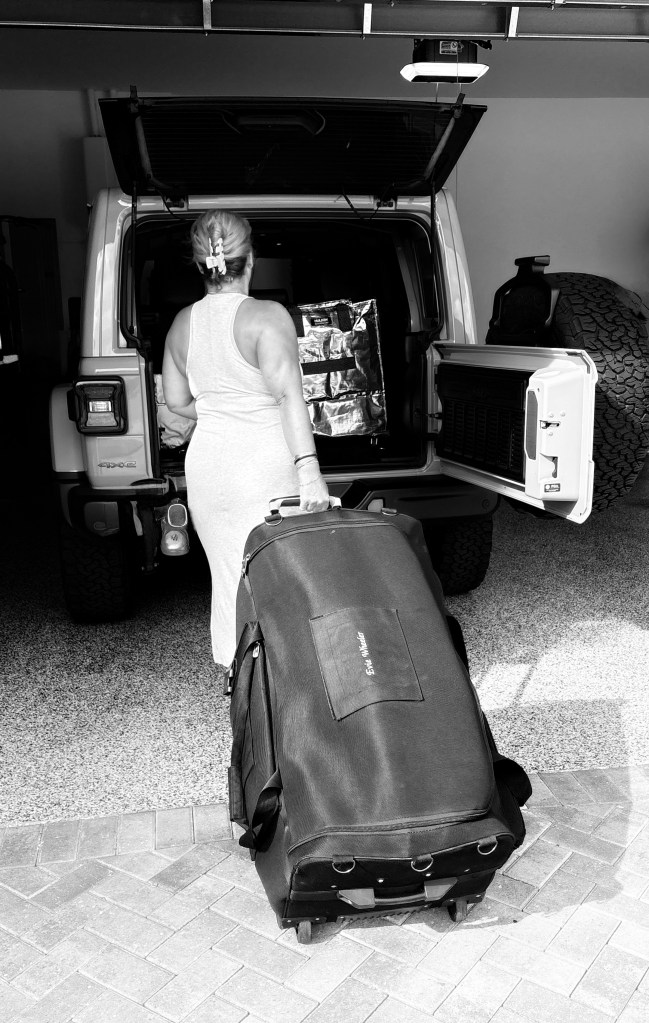
We made multiple, back-and-forth trips to the car, hauling luggage, makeup cases, and costumes. My friend and I looked at each other in the elevator, completely weighed down, and joked:
“We’re just their Sherpas.”
How did we fall into this trap?
I know all parents can relate, because to some degree, we all do it. But out of pure survival, I tried to draw hard boundaries and instill strict rules early on so that the entire weight of the logistics wouldn’t fall on me.
When my husband was still playing baseball, he was on the road constantly, and I was the sole caretaker for about nine months of the year. I was the one navigating multiple school schedules, getting the boys to baseball practice, and driving my daughter to dance.
I vividly remember after a little league game, my son got home and realized he was missing his baseball glove. He looked at me with teary eyes, desperately wanting to know what we were going to do about it.
I put a message out on the parent group chat, and thankfully, another family had picked it up. Problem solved.
But not really.
Once the panic subsided, I sat down and had a real conversation with my son, who was only six at the time. I looked him in the eye and said: “I am not responsible for your stuff.”
I needed him to learn the skill of self-reliance. Of course, because I’m a mom and he was only six, I would secretly double- and triple-check behind him, but the baseline rule was established: your gear is your responsibility.
Years later, when my husband retired, he took over the baseball carpools. Our oldest son had become unbelievably organized by then—his bag was always packed and ready to go. Our second son, however, hadn’t quite received the memo yet.
My husband is a natural giver, so he quietly slipped into the habit of packing our younger son’s gear for him.
One evening, because the boys were playing on two different teams, I had to drive our younger son to his practice. We arrived at the fields, and he glanced into the backseat.
“Mom, where’s my baseball bag?”
I looked at him calmly. “I am not responsible for your stuff. It is your responsibility to make sure your bag is in this car.”
Now, because I am also an enabler, I didn’t make him sit on the bench in silence. I dropped him off, sped all the way back home, grabbed the bag, and raced back to the fields. But I made him pay a price for the rescue: he had to walk up to his coach, look him in the eye, and apologize for being unprepared for practice.
After that night, he started making an effort.
Later that evening, I replayed the whole saga to my husband. “We have to get on the same page,” I told him. “With three kids in three different intense activities, our lives are too hectic. They need to start assuming their own weight.”
For a while, it felt like I had hit the lottery. My daughter took over her own competitive dance packing early on. If you looked up the word efficiency in the dictionary, her picture would be right next to it.
But watching myself hustle through that hotel lobby, surrounded by rows of parents loading up heavy Dream Duffels and luggage while the kids walked ahead unburdened with their Starbucks refreshers in hand, I realized we’ve taken a few steps back.
My children are wonderful, and they genuinely do a lot—but maybe my expectations are just higher because of how I was raised.
My mother ran a fiercely tight ship. If we had a housekeeper coming, my job was to thoroughly dust and vacuum the house the day before the cleaners arrived. I was responsible for cleaning the kitchen every single night after dinner starting in the fourth grade. By middle school, helping with the actual meal prep was just part of the daily rhythm. That’s just how it was.
We are a team in this house, and for the most part, my kids pick up their slack. My husband’s career on a sports team definitely prepared him to understand that everybody has to work together to keep the household soul intact.
But lately, a little laziness has crept in. Finding those crusty pasta dishes in the sink wasn’t a one-time offense; it’s becoming a pattern.
Our eldest has been away at college for the last few years. When he comes home, he handles his own laundry and manages his life because living on his own forced him to. Our second son is about to head off to college, and frankly, I’m a little nervous. He isn’t quite as naturally organized as his siblings, but when the pressure is on, he always manages to get done what needs to get done. So we shall see.
As parents, our default setting is to want to do absolutely everything for our kids. But what is really happening is we are denying our children responsibility.
We need to stop feeling guilty about demanding accountability. It is entirely okay to give ourselves some grace—the perfectionist in me is always pushing, and a little laziness is human—but when our kids hit a certain age, they have to pull their weight.
I don’t know how many times I’ve said it out loud to my kids over the last two decades, but the message remains the same:
I love you. But I am not responsible for your stuff.
How many of you need to start saying that out loud to yours?


Leave a Reply